how to choose the perfect leather jacket
Care and Maintenance

How to Choose the Perfect Leather Jacket: A Complete Buyer’s Guide

Finding the right leather jacket can be a challenge. It needs to match your personal style, fit your body perfectly, and feel comfortable enough to wear every day. In this guide, we will break down the essential steps to picking a jacket that looks great and lasts for decades. Additionally, you can shop at Pelnoir for a premium experience, where you will find the best-fitting jacket to elevate your personal wardrobe and showcase your fashion sense. Also read our blog: Authentic Leather Guide: How Global Buyers Identify Genuine Grades Table of Content 1. Identify Your Style and Needs2. Key Factors to Check Before Buying3. FAQs4. Conclusion Discover the Real leather Jacket with free delivery! Identify Your Style and Needs Before you buy, think about where you will wear the jacket. Are you looking for something casual for daily use or a polished piece for formal events? Also read our blog: Custom Leather Jacket Manufacturers: The Global Sourcing Guide Key Factors to Check Before Buying To ensure you are making a worthy investment, pay close attention to these high-quality details: The Leather Grain The specific type of grain used is one of the most critical things to check when purchasing a jacket. You will typically find options like full-grain, top-grain, and genuine leather. Full-grain leather is widely considered the premium choice because it keeps the natural texture and unique marks of the hide, making it exceptionally durable. Selecting the right grain is especially important if you are planning to style a moto leather jacket. The grain you choose directly impacts how long the jacket lasts and how beautifully it ages over the years. High-quality leather develops a stunning finish over time, creating a smooth surface that helps you make a bold fashion statement. At Pelnoir, we offer real leather jackets crafted from 100% authentic, pure leather that is ethically sourced from top-tier suppliers. Stitching Quality The quality of a jacket is often defined by its stitching. You should look for tight, straight, and consistent stitches, as loose or crooked sewing can lead to quick damage. For those who plan to wear their jacket daily, choosing a design with double-stitched layers is a great move for added durability. Beyond strength, high-quality stitching ensures your jacket looks polished and sophisticated. Inner Lining Don’t overlook the leather jacket lining, as it is essential for both warmth and comfort. Premium jackets often feature linings made from silk, cotton, or high-grade polyester to improve the overall wearing experience. A quality lining makes the jacket easier to put on and take off while providing necessary insulation during the colder months. Sleeves and Mobility The design of the sleeves is a major factor in how comfortable the jacket feels. A well-constructed sleeve allows for a full range of arm movement. If the armholes or sleeves are too tight, the jacket will feel restrictive. When trying on a jacket at Pelnoir, we recommend moving your arms in a circle to test the fit; this small detail ensures long-term comfort and satisfaction. Reliable Zippers For a jacket to be functional and durable, it needs high-quality zippers. Always look for heavy-duty metal zippers rather than plastic ones, as metal is far more reliable. A smooth-gliding zipper prevents frustration and potential damage to the leather. This is a detail you should never ignore, especially when you are styling a leather bomber jacket. Collar Styles The collar can completely change the vibe of your leather jacket. Options range from classic lapels to sleek mandarin collars, each offering a unique look. Choose a style that complements your existing wardrobe and matches your personal aesthetic. A sharp, well-structured collar adds an immediate layer of sophistication to your outfit. Lapel Designs The lapel serves both a functional and stylistic purpose. Common types include notched, shawl, and peaked lapels. Notched lapels are perfect for a casual, everyday style, whereas peaked lapels provide a more formal and elegant appearance. Your choice should reflect how and where you plan to wear the jacket. Sleeve Length and Sizing Finding the right jacket size and sleeve length is the secret to a sharp look. Ideally, the sleeves should end just past your wrist to allow for movement without looking too baggy. Whether you prefer a slim, relaxed, or oversized fit, knowing your measurements and trying on different sizes will help you find the best match for your body type. FAQs Conclusion Buying a high-quality leather jacket is an investment that instantly elevates your wardrobe with timeless charm. By understanding how to evaluate quality and fit, you can make a confident purchase that will last for many years. Always keep factors like material, comfort, and functionality in mind during your final selection. We hope this ultimate guide helps you make the best decision for your style. For premium, high-quality leather jackets that offer a bold look and match your personal taste, look no further than Pelnoir—your destination for exceptional craftsmanship and style.

leather pricing strategy
B2B Leather Insights

Global B2B Leather Pricing Strategy: Maximize Profit Margins for Your Business

In the global B2B leather market, maximizing profit margins is not about charging the highest price; it’s about optimizing your Cost of Goods Sold (COGS) and mastering a strategic pricing model. After two decades in the industry, I have seen too many brands underprice their products due to inaccurate cost calculations or overprice them due to inefficient sourcing. Your pricing strategy must be transparent, sustainable, and built on a foundation of efficient manufacturing. Therefore, this guide breaks down the essential components of a winning Global B2B Leather Pricing Strategy, showing you how partnering with Pelnoir offers immediate financial advantages. 1. The Foundation: Accurately Calculating COGS for Leather Goods You cannot set profitable pricing until you have an ironclad understanding of your Cost of Goods Sold (COGS). For leather goods, COGS is more complex than just the manufacturer’s invoice. Key Components of COGS (The True Cost): Component Description Pelnoir’s Impact on Cost Reduction Material Costs Raw hide, lining, zippers, thread, hardware. Vertical Integration. We control material sourcing (leather and hardware) in-house, eliminating supplier markups. Labor Costs Cutting, stitching, finishing, and QC. Efficiency. Our streamlined production lines and efficient labor structure ensure competitive per-unit assembly costs. Manufacturing Overhead Factory utilities, maintenance, QA staff. Volume. Our scale distributes fixed costs across high volume, lowering the overhead per unit for our partners. Logistics & Duties Freight, import tariffs, customs clearance. Experience. We manage the end-to-end global logistics, minimizing unexpected fees and optimizing container usage. In short, many brands only account for the invoice price. Crucially, you must include every element above to get your true COGS. 2. Strategic Sourcing: Your Biggest Margin Lever Your manufacturer is your most powerful tool for Manufacturing Cost Reduction. At Pelnoir, our Strategic Leather Sourcing model is designed to convert operational efficiency into your margin advantage. A. Material Optimization: The Vertical Advantage As a vertically integrated manufacturer, we eliminate the 15-25% markup typically added when tanneries sell to manufacturers. Consequently, our partners receive leather at a cost much closer to its raw value. This single factor immediately increases your gross margin. B. MOQ Flexibility High MOQs force you to hold excessive inventory, driving up warehousing costs and the risk of obsolescence. Therefore, Pelnoir’s flexible, low MOQ structure allows you to order just in time for demand, protecting your cash flow and ensuring high inventory turnover. C. Waste Reduction Our advanced cutting technology and expert patterning minimize leather waste (yield loss). In this way, you pay for less unused material, further driving down the material cost per unit. 3. Choosing the Right Wholesale Leather Pricing Models Once you know your COGS, you must select a pricing model that reflects your brand value and market positioning. A. Keystone Pricing (The Baseline) This is the simplest model: COGS multiplied by two. However, in luxury leather, this often results in underpricing. B. Value-Based Pricing (The Luxury Model) Set prices based on the perceived value your customer receives. If your product uses Full-Grain leather, LWG-certified sourcing, and bespoke hardware, then your product is not competing on cost; it is competing on quality, history, and ethics. This allows for margins exceeding 60-70%. C. Tiered Pricing (The Scalability Model) Offer lower per-unit prices to larger volume B2B buyers (e.g., retailers). For example, a Tier 1 buyer ordering 50 units pays $X, but a Tier 3 buyer ordering 500 units pays $X – 15%. This incentivizes growth and volume commitment. Conclusion: Achieve Sustainable Profitability A successful Global B2B Leather Pricing Strategy moves beyond simple cost-plus formulas. It requires sophisticated, Strategic Leather Sourcing that focuses on Manufacturing Cost Reduction at the source. By partnering with Pelnoir, you are not just getting a manufacturer; you are securing a transparent, integrated supply chain partner committed to helping you Maximize Profit Margins B2B. We deliver guaranteed quality at an optimized COGS, ensuring your prices are competitive and your business is sustainably profitable. Ready to gain financial control and maximize your margins? Contact the Pelnoir team today to discuss COGS analysis for your next custom order.

leather supply chain
Craftsmanship & Quality

The Pelnoir Advantage: End-to-End Global Leather Supply Chain Control

For two decades, I have watched brands succeed or fail based on one thing: control over their manufacturing pipeline. In the complex world of leather goods, a fragmented supply chain is your biggest liability. Dealing with separate tanneries, cutting houses, and stitching factories introduces delays, quality drops, and critical ethical breaches. Therefore, smart Global Leather Supply Chain Management requires a shift from fragmented vendors to a single, vertically integrated partner. This is the Pelnoir Advantage. We do not just stitch your products; we own the process from the raw hide to the final packaged good. This End-to-End Leather Sourcing model drastically reduces manufacturing risk and secures your brand’s reputation. 1. The Core Problem: Fragmentation and Risk Most B2B leather sourcing involves 3-5 separate entities. Each transition point is a risk zone: Hand-Off Point Risk Factor Pelnoir Solution Tannery to Cutter Inconsistent material grade, improper moisture content, delays. Integrated Tanning & QC. We control the hide preparation. Cutter to Stitcher Poor yield management, cutting errors, waste, and component mismatch. In-House Cutting Floor. Zero hand-off errors; perfect alignment with patterns. Stitcher to Logistics Packaging mistakes, final QC lapses, and customs documentation errors. Dedicated Logistics & Final Audit. Single team handles packaging and freight. Consequently, if you lack visibility into these stages, you cannot guarantee quality or delivery time. 2. Pelnoir’s Vertical Integration: A B2B Quality Control Guarantee Vertical Integration Leather means Pelnoir manages every critical step in-house. This complete control is our promise of consistency and ethical compliance. A. Raw Material Mastery (Tanning and Finishing) We select high-grade hides and control the tanning process. Specifically, this allows us to produce custom colors, textures, and temper exactly to your specifications. B. Precision Manufacturing (Cutting and Stitching) Our design and production teams work under one roof. Thus, we ensure maximum precision. 3. Ethical Sourcing and Transparency: Built-in Compliance Today’s global consumer demands Ethical Leather Sourcing B2B. Our integrated model makes compliance a core function, not an afterthought. 4. The Strategic Advantage: Scaling with Confidence This level of operational control translates directly into business benefits, regardless of your brand’s size: Conclusion: Stop Managing Risk, Start Growing Managing a fragmented supply chain is a heavy administrative burden. The Pelnoir Vertical Integration Leather model transforms this process into a clear, single-point solution. We handle the complexity of Global Leather Supply Chain Management so you can focus entirely on design and sales. Ready to gain total control, achieve consistent quality, and partner with a manufacturer dedicated to reducing manufacturing risk? Contact Pelnoir today to secure your End-to-End Leather Sourcing strategy and discuss your next custom collection.

custom leather jacket manufacturers
B2B Leather Insights

Custom Leather Jacket Manufacturers: The Global Sourcing Guide

If you are a fashion brand, retailer, or startup, finding reliable Custom leather jacket manufacturers is the most critical step to success. Customization is no longer a luxury; it is a necessity. Your brand needs unique fits, bespoke hardware, and exclusive designs to stand out. You need a manufacturing partner who acts as a true Custom leather jacket Maker—one who can translate a complex vision into a perfectly crafted, high-quality garment. This is where Pelnoir excels. We specialize in bespoke production, offering full private label services to brands worldwide, positioning us as a leading Global Leather Jacket Manufacturer focused on your success. 1. Why Choose a Custom Leather Jacket Maker Online? The modern supply chain demands speed and flexibility. Partnering with a skilled Jacket Maker online offers significant advantages over traditional wholesale sourcing: 2. Our Expertise: From Vintage Replicas to Modern Biker Gear Your customer base is diverse, and your product line must reflect that. We cover the full spectrum of leather apparel, ensuring you can compete directly with established brands like Wilsons leather. 3. Global Reach: Manufacturing without Borders For US and European brands, logistics and quality assurance are major concerns. Pelnoir simplifies this process. As a prominent Global Leather Jacket Manufacturer, we manage the entire supply chain from raw hide to final delivery. While our state-of-the-art manufacturing facilities operate in Pakistan, we maintain seamless logistics to ensure efficient delivery. Therefore, whether you need a Leather jacket manufacturer usa support team or direct international freight, we handle the complexities. Our Customization Process: Ready to Launch Your Signature Collection? Don’t settle for off-the-rack wholesale. Your brand deserves quality and exclusivity. Choosing the right Custom leather jacket manufacturers is the key to unlocking higher margins and stronger customer loyalty. Partner with Pelnoir, the Best custom leather jacket Maker, and leverage our expertise to bring your most demanding designs to life with guaranteed quality and flexible production volumes. Contact the Pelnoir team today to start designing your custom leather collection.

wholesale leather ladies bags manufacturer in pakistan
B2B Leather Insights

Wholesale Leather Ladies Bags Manufacturer in Pakistan

In women’s fashion, finding the right manufacturing partner makes the difference between success and failure. Global brands and emerging designers often face a common frustration when searching for a reliable Wholesale Leather Ladies Bags Manufacturer in Pakistan: high Minimum Order Quantities (MOQs) stifle creativity and cash flow. However, Pakistan remains a global powerhouse for leather goods, known for its exquisite craftsmanship and access to premium hides. The real challenge is finding a factory that combines this quality heritage with modern flexibility. This is where Pelnoir steps in. We redefine the manufacturing landscape. We offer world-class leather handbags with low or even zero MOQ structures. This design specifically helps B2B buyers launch and scale without the burden of massive inventory. Why Pakistan is the Premier Choice for Leather Handbags Before diving into logistics, understand why top global brands source from this region. Pakistan is not just a production hub; it is a center of leather excellence. The Pelnoir Difference: Low & Zero MOQ Manufacturing Most manufacturers demand orders of 500 or 1,000 units per style. For a growing brand, this is a massive risk. At Pelnoir, we operate differently. We believe in partnership, not just production volume. 1. Zero MOQ for Prototyping We understand you cannot sell a sketch. Consequently, we offer a Zero MOQ policy for sampling. You can order a single prototype of your custom design. This approach allows you to inspect the leather quality, test the functionality, and feel the finish before you commit to a production run. 2. Low MOQ for Production Runs Once you approve the sample, we offer industry-leading low MOQs for your main order. Whether you need 20 pieces for a capsule collection or 200 for a seasonal launch, our agile manufacturing lines accommodate you. This flexibility allows you to: Private Label Services: Your Brand, Our Craftsmanship We are not just a factory; we are your backend design studio. As a premier leather bag factory in Pakistan, we specialize in comprehensive Private Label services. Uncompromising Quality Control for Fashion Brands In the fashion industry, a single defect can ruin a brand’s reputation. Therefore, Pelnoir enforces a rigorous Quality Control (QC) protocol specifically for high-end leather goods. Start Your Collection with Pelnoir Today If you are searching for a Wholesale Leather Ladies Bags Manufacturer in Pakistan that understands the needs of modern retail, your search ends here. You no longer have to choose between high quality and low risk. With Pelnoir, you get the best of Pakistani craftsmanship with the flexibility of low MOQ manufacturing. Let us handle the production complexities so you can focus on designing and selling your next best-selling collection. Ready to bring your bag designs to life? Contact Pelnoir today to request your sample and start your journey.

leather jacket manufacturers in pakistan
B2B Leather Insights

Leather Jacket Manufacturers in Pakistan: Finding Your Best B2B Partner

For global brands seeking a balance of exceptional craftsmanship, authentic leather materials, and competitive pricing, Leather Jacket manufacturers in Pakistan consistently top the list. Pakistan’s leather industry, particularly anchored in cities like Sialkot and Karachi, has a deep, multi-generational history of producing garments that meet rigorous international standards. However, navigating the choices can be challenging. Many suppliers impose high Minimum Order Quantities (MOQs) or lack the transparency required by modern B2B buyers. Fortunately, Pelnoir stands apart. We blend this rich heritage with modern, flexible manufacturing to become the premier partner for brands of all sizes, from agile startups to established retailers seeking high-volume quality. Why Pakistan Dominates the Leather Jacket Market Pakistan’s strength in leather jacket manufacturing rests on a few key, strategic advantages: The Pelnoir Advantage: Your Risk-Free Path to Quality While many Leather Jacket manufacturers in Pakistan offer volume, few offer the flexibility and partnership assurance that Pelnoir guarantees. We focus on eliminating the three biggest pain points for global buyers: 1. Low or Zero MOQ: Designed for Growth The high MOQ barrier often cripples startups and limits established brands from testing new designs. Consequently, Pelnoir structures our service to remove this risk: This commitment to low MOQ allows you to enter the market faster, test designs affordably, and scale up production only when demand is validated. 2. Uncompromising Quality and Transparency We understand that quality is non-negotiable. We do not use Bonded or Genuine Leather for garments. Instead, we guarantee the use of authentic, high-grade materials: 3. Your Private Label Customization Partner Your jacket should be unique. Pelnoir specializes in Private Label leather jackets. We work directly with your design specifications, offering customized options for every element: Ultimately, we help you turn a design sketch into a distinct, market-ready product that is exclusive to your brand. Vetting Your Partner: Why Pelnoir Checks Every Box Choosing the right manufacturer requires careful due diligence. If you are serious about B2B leather jacket sourcing, you need a partner who can provide proof of quality, ethical compliance, and financial stability. Pelnoir meets all criteria on the essential Vetting Leather Manufacturers Checklist: Convert to a Lead: Start Your Partnership with Pelnoir If you are currently evaluating Leather Jacket manufacturers in Pakistan and are searching for a partner who guarantees quality, respects your startup budget with low MOQs, and offers unparalleled custom private label specialization, your search ends here. Do not compromise your brand integrity or waste capital on untested suppliers. Pelnoir is ready to be the scalable, reliable, and ethical manufacturing arm of your global leather business. Contact the Pelnoir team today to discuss your jacket design, request low-MOQ samples, and begin your production run.

vetting leather manufacturers
B2B Leather Insights

Vetting Leather Manufacturers: A B2B Partner Selection Checklist

Selecting the right leather manufacturer is the single most important decision for your brand’s quality, scalability, and reputation. In the global B2B landscape, a manufacturer is more than a vendor—they are an extension of your brand identity and a key partner in supply chain management. Consequently, due diligence is non-negotiable. Skipping steps in the vetting process can lead to inconsistent quality, costly delays, and severe compliance issues. Therefore, we present this comprehensive checklist to help B2B buyers confidently evaluate and secure the ideal manufacturing partner. Part 1: Production Capability and Quality Assurance This section focuses on the manufacturer’s technical skill, consistency, and ability to handle your projected scaling needs. 1. Proof of Consistent Quality (QC) 2. Capacity and Scalability Part 2: Transparency and Ethical Compliance In today’s market, ethical sourcing and environmental compliance are brand requirements, not optional extras. Your manufacturer must share your commitment to a responsible leather supply chain. 3. Environmental Standards (The Tannery Link) 4. Social and Labor Compliance Part 3: Logistics, Communication, and Partnership Fit A long-term partnership requires seamless communication and robust logistics infrastructure to handle international shipping complexities. 5. Communication and Management 6. Financial and Logistical Capabilities Conclusion: Securing Your Strategic B2B Partner The process of vetting leather manufacturers is your insurance policy. A manufacturer that scores highly across this B2B partner selection checklist proves they have the infrastructure, ethics, and transparency necessary to be a reliable and scalable partner. At Pelnoir, we proudly operate with the highest LWG standards and maintain complete transparency across our production and supply chain management. We are dedicated to providing the stability and ethical assurance your brand needs to scale globally. Ready to partner with a manufacturer that meets every point on your checklist? Contact the Pelnoir team today to schedule an introductory audit and review our certifications.

15 profitable small business ideas to start today
Leather Business Trends

15 Profitable Small Business Ideas to Start Today

In today’s digital economy, launching a successful business no longer requires a massive loan or a large storefront. The best small business ideas blend low overhead, high scalability, and specialized expertise. Whether you’re looking for a side hustle or your next full-time venture, the key is finding a niche you’re passionate about where you can deliver unmatched quality. Here are 15 small, profitable business ideas tailored for the modern entrepreneur, focusing on areas where quality and specialization win. I. Niche Product-Based Businesses These ideas are centered around selling curated, high-quality goods, often leveraging dropshipping, low-inventory models, or custom sourcing. 1. Curated Niche E-commerce Store (The Quality Focus) Instead of selling everything, focus on one highly specific category—like minimalist outdoor gear, specialty coffee accessories, or, crucially, high-end, custom-sourced goods. Success here relies entirely on product quality and brand story. 2. Subscription Box Service Subscription boxes are still booming, but modern customers demand more than just random items; they want a highly themed, exclusive experience. Think “Sustainable Self-Care,” “Gourmet International Spices,” or “Luxury Sourcing Samples.” 3. Sustainable and Ethical Retail Consultancy Businesses across all sectors are scrambling to meet rising consumer demand for sustainability. A consultancy that helps small retailers audit their supply chain and source ethical materials can be highly valuable. 4. Private Label Sourcing Specialist If you have a knack for finding high-quality, reliable suppliers, you can start a business helping other small brands launch their own lines without the stress of managing global logistics. II. Service-Based Businesses (Low-to-Zero Inventory) These businesses leverage your time, skills, and expertise, minimizing the need for physical stock. 5. Specialized Content Writer / Copywriter The internet runs on content. Focus your writing on a profitable niche like SEO optimization, technical documentation, or sales copy for B2B products. 6. Social Media Management for Local Businesses Many local service providers (dentists, mechanics, independent boutiques) struggle with social media. Offer tailored management and content creation focused purely on their immediate, local audience. 7. Virtual Assistant for E-commerce Operations E-commerce owners are often swamped with tasks like inventory updates, customer service, and drafting product descriptions. An organized VA who specializes in e-commerce platforms (like Shopify or WooCommerce) is invaluable. 8. Local Experience / Tour Planner In tourist hubs or even under-the-radar local communities, create highly personalized, curated experiences that go beyond the standard tour. Think “Historic Architecture Photo Walk” or “Foraged Ingredients Cooking Class.” III. Digital & Creative Businesses These ideas capitalize on the perpetual need for digital transformation and online presence. 9. Website Design and Maintenance (Niche Focus) Instead of offering general web design, specialize. For instance, only build sites for real estate agents, or only design websites using a specific, rapid development framework. 10. SEO Audit and Strategy Consultant Search Engine Optimization (SEO) is complex. Offer detailed audits that identify a business’s exact shortcomings and provide a practical plan for fixing them. 11. Custom Digital Asset Creation (Templates, Presets) Create and sell digital products that solve a common problem for a specific group of professionals: 12. Remote Technical Support Provide on-demand troubleshooting and technical assistance to individuals or small businesses who can’t justify a full-time IT department. IV. Practical Skill & Importing Businesses These require a hands-on approach or specialized knowledge in logistics. 13. Apparel/Goods Sourcing Consultant Help small U.S. retailers navigate the complexities of international trade. You could specialize in a single region or product type, becoming the go-to expert for reliable importation. 14. Small-Batch Maker/Crafter If you have a skill like woodworking, soap making, or even specialized knitting, focus on small-batch, high-quality production. Sell directly online to maximize profit margins. 15. Local Delivery and Courier Service (Specialized) Start a delivery service that focuses on high-value, time-sensitive goods like medical supplies or documents, where reliability and speed are worth a premium. Ready to Launch? The common thread among the most successful small businesses is the focus on solving a specific problem with high-quality execution. Once you’ve chosen your idea, remember that scaling is the next step. Don’t wait for perfection—launch with what you have and commit to learning the sourcing and logistics of your industry. For those of you leaning toward retail, our content on ethical sourcing and global partnerships can help you build a reliable supply chain from day one. External Resource: For official advice on structuring your business and securing funding, we recommend checking out the guide on Starting and Managing a Business from a respected business publication like Inc.

authentic leather guide
Craftsmanship & Quality

Authentic Leather Guide: How Global Buyers Identify Genuine Grades

For global B2B buyers, the term “Genuine Leather” often feels like a promise of quality. However, in the complex world of leather grades, that label is frequently misunderstood and sometimes intentionally misused. Your brand’s reputation, product durability, and profit margins hinge on accurately identifying and sourcing authentic leather grades. Crucially, confusion around grades—from Full-Grain to Bonded—can lead to costly mislabeling and dissatisfied customers. Therefore, we created this definitive guide. It equips global buyers with the knowledge to inspect materials confidently and secure a transparent supply chain. The Four Pillars of Authentic Leather Grades Leather is graded based on which layer of the hide is used and how much it has been processed. Understanding these distinctions is fundamental to effective B2B leather sourcing. 1. Full-Grain Leather: The Pinnacle of Quality Full-Grain Leather is the gold standard. Specifically, it retains the entire natural grain layer, including all imperfections and natural pore structures. This lack of sanding or correction results in the strongest, most durable leather available. 2. Top-Grain Leather: Balancing Strength and Flexibility Top-Grain Leather is the second-highest grade. In this process, manufacturers slightly sand or buff the outermost layer to remove natural blemishes and imperfections. This results in a more uniform and manageable surface. 3. Genuine Leather: The Caveat Emptor Grade The term Genuine Leather is perhaps the most misleading in the global market. In reality, it means the material is technically leather, but it typically comes from the inner, weaker layers (the “split”) or is composed of multiple layers bonded together. 4. Bonded Leather: The Lowest Tier Also known as reconstituted or blended leather, Bonded Leather is the lowest grade. In essence, it consists of leather scraps and fibers that manufacturers grind up and mix with chemical binders, then roll onto a fiber backing. The percentage of actual leather can be minimal (often less than 10%). How Global Buyers Confidently Identify Authentic Grades As a B2B buyer, your ability to identify genuine leather extends beyond reading labels. You must know how to inspect the physical product, especially when sourcing internationally. Inspection Checklist for Quality Control Conclusion: Partnering with Transparency is Your Best Defense Protecting your brand’s promise of quality begins with protecting your sourcing process. Ultimately, the surest way to guarantee your inventory consists of the authentic leather grades you ordered (especially the coveted Full-Grain and Top-Grain) is to partner with a transparent, quality-focused manufacturer. At Pelnoir, we commit to using only high-quality hides and providing full clarity on the grade and tanning process used for every B2B order. We understand that transparency is the foundation of a successful global B2B partnership. Ready to source guaranteed authentic leather grades for your next collection? Contact the Pelnoir team today to discuss your quality requirements and request samples.

scaling your leather business
B2B Leather Insights

Scaling Your Leather Business: From Startup to Global Market Leader

Every successful brand began as a startup. Consequently, the journey from managing small batch orders to commanding a global supply chain requires more than just high sales—it demands systematic, strategic growth. For a leather business, scaling successfully means optimizing your production, standardizing quality, and leveraging global partnerships to meet escalating demand without sacrificing brand integrity. If your ambition is to transition from a local favorite to a global market leader, you must move through three distinct phases of operational maturity. Here is your comprehensive guide to scaling your leather business. Phase 1: Product Foundation and Validation (Startup to Stability) At this stage, your focus is validating demand and establishing the manufacturing framework that can handle growth. Initially, many startups prioritize low cost, but true scaling requires investing in long-term quality and repeatable processes. 1. Define Your Differentiation Identify the specific niche your products fill. Is it highly customized functionality, unparalleled craftsmanship, or sustainable materials? First, you must solidify your unique selling proposition (USP). This unique value justifies higher pricing and builds strong brand loyalty, which is essential for surviving the transition to large-volume orders. 2. Choose the Right Manufacturing Model This is the most critical decision. Therefore, choose the production model that supports your long-term vision. 3. Standardize Materials and Quality Never compromise on the base materials. Select and lock in the leather grades, hardware, and linings you will use consistently. For example, if your brand promises durability, you must commit to Full-Grain Leather and establish rigid quality control (QC) protocols from the very first sample. Standardized inputs ensure every subsequent production run maintains the same high standard. Phase 2: Operational Maturation and Standardization (Stability to Expansion) Once you have a proven product and steady demand, the challenge shifts to systemizing your operations to handle substantial volume increases. This phase focuses on efficiency and reducing risks across your leather supply chain. 1. Optimize the Sourcing Partnership Work closely with your manufacturer (like Pelnoir) to streamline communication and process flow. In this phase, you should be moving toward larger, more predictable Minimum Order Quantities (MOQs). Larger MOQs demonstrate commitment and allow your supplier to dedicate resources, typically resulting in lower unit costs and better production timelines. 2. Establish Rigorous Quality Gates Scaling quickly often leads to quality erosion if not managed correctly. Therefore, implement clear quality checkpoints: Understanding the nuances of the leather itself is key to this. Specifically, review the differences between different leather types to ensure your QC team knows what to look for: Reference our guide: Defining Leather Grades. 3. Systemize Logistics and Inventory Simultaneously, develop a robust logistics strategy. As you scale, relying on single-shipment logistics becomes inefficient. Partner with your manufacturer to plan freight and warehousing capacity several months in advance. Utilizing technology for inventory forecasting helps you order accurately, minimizing both costly overstock and missed sales opportunities due to stockouts. Phase 3: Global Expansion and Leadership (Expansion to Leader) This final phase focuses on cementing your status as a global market leader by expanding into new geographic markets and establishing undeniable brand authority. 1. Diversify Market Presence Target new regions beyond your core market. Crucially, this means adapting your products slightly for regional tastes—such as color preferences, size standards, or legal labeling requirements—while maintaining your brand’s core aesthetic. Furthermore, leveraging a single, reliable global manufacturer simplifies this process, as you manage manufacturing centrally but distribute locally. 2. Leverage Ethical and Transparent Sourcing Today’s global consumers demand sustainability and ethics. Use your B2B partnership with Pelnoir to tell a compelling story about your supply chain. Highlighting responsible manufacturing practices, fair labor standards, and adherence to international environmental protocols (like those set by Leather Working Group) builds trust and elevates your brand’s authority, turning a compliance issue into a powerful marketing tool. 3. Invest in Digital Infrastructure Finally, true scaling depends on technology. Invest in Enterprise Resource Planning (ERP) systems or robust supply chain software that can communicate seamlessly with your manufacturer’s systems. This integration ensures real-time data on production capacity, material stocks, and shipping timelines, giving you the agility required to lead the global market. Conclusion: Partnering for Global Domination Scaling your leather business requires shifting your mindset from reactive selling to proactive, systematic manufacturing management. The most successful global market leaders view their manufacturer not just as a vendor, but as an integral strategic partner. Pelnoir provides the standardized quality, custom Private Label capabilities, and streamlined global logistics necessary to support your ambition. Ready to turn your startup vision into a worldwide success story? Contact the Pelnoir team today to discuss your global scaling strategy.

private vs. white label leather
B2B Leather Insights

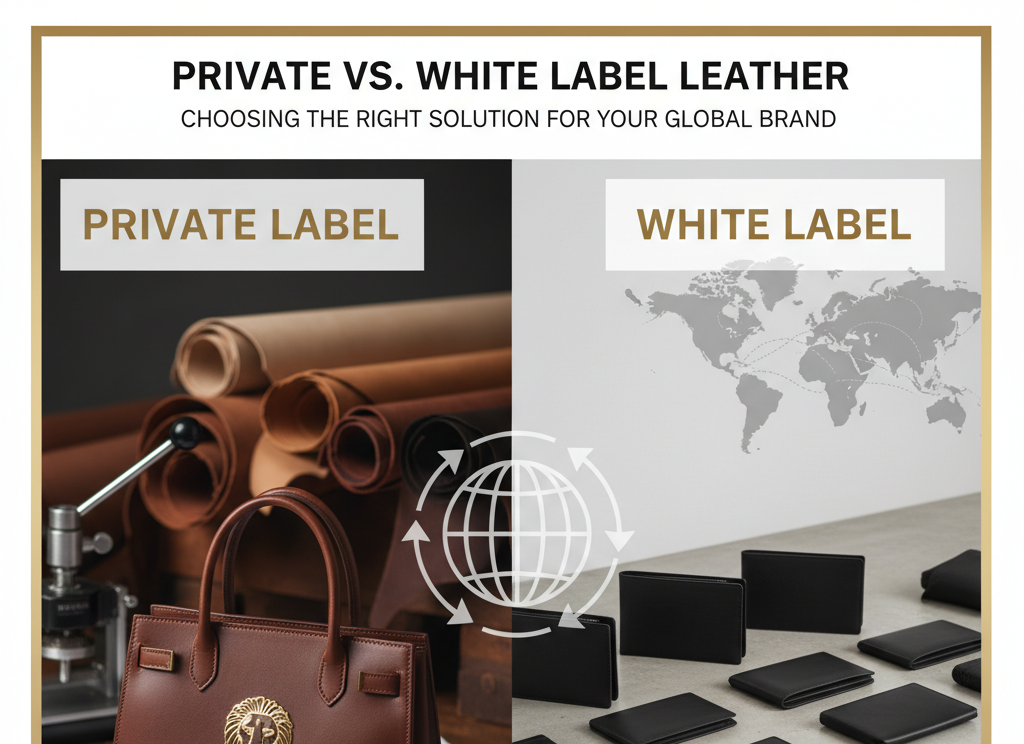
Private vs. White Label Leather: Choosing the Right Solution for Your Global Brand

Choosing the right manufacturing partnership is a critical early decision for any brand entering or expanding within the global leather market. Many people misunderstand the difference between Private Label Leather and White Label Leather. Crucially, this difference dramatically affects your control over design, your cost structure, and your market differentiation. Knowing which path to choose is essential for scalable global brand sourcing. The Core Distinction: Generic vs. Exclusive Design The fundamental difference is simple: White Label involves purchasing an existing, pre-made product from Pelnoir, where you only add your brand’s logo. Think of it like buying a standardized leather phone case that dozens of other brands sell. In contrast, Private Label means we manufacture a product based entirely on your unique design, from specialized pocket placement to custom dimensions, ensuring you own a completely exclusive item—like a signature travel backpack designed only for your brand. White Label Leather: Efficiency and Speed White Label Leather refers to generic, pre-designed products that Pelnoir (or any supplier) sells to multiple brands. Your brand adds its logo and packaging; however, the core product design remains fundamentally unchanged. Key Characteristics: Strategic Trade-Offs: In short, the primary drawback is the lack of brand uniqueness. If your competitor sources the same white label design, you are competing solely on price and marketing. B2B Application: White Label is best for brands that need to quickly fill inventory gaps, test new product categories without heavy investment, or offer entry-level price points in their catalogue. Private Label Leather: Customization and Differentiation Private Label Leather means we manufacture a product exclusively for your brand based on your unique specifications. Pelnoir works with you on every detail: from design sketches and material choice (e.g., custom colored Full-Grain Leather) to hardware, dimensions, specialized features, and pattern construction. Key Characteristics: Strategic Trade-Offs: However, this model requires a higher initial investment for tooling, patterns, and prototyping. Furthermore, it involves longer lead times because of the necessary testing and refinement process. Typically, it also requires higher MOQs. B2B Application: Private Label is ideal for established brands that focus on building a unique identity, developing signature products with specialized functionality, and commanding premium pricing and luxury positioning in the global market. Making the Strategic Choice for Your Global Brand The choice between White Label and Private Label is not always an “either/or” situation. In fact, many successful global brands use a hybrid strategy: Ultimately, choosing the right partner is paramount. As a comprehensive manufacturer, Pelnoir supports both strategies. We excel at executing tight Private Label Leather specifications, ensuring your custom product meets the exact quality and material specifications required for your brand’s unique value proposition. In conclusion, the choice between Private Label and White Label is strategic; it connects directly to your brand’s mission, budget, and desired market uniqueness. For long-term success and global growth, investing in custom Private Label designs is the proven path to building defensible brand equity. Ready to launch your signature line? Contact the Pelnoir team today to discuss a customized manufacturing strategy that elevates your global brand.

niche leather markets 2025
Leather Business Trends

Niche Leather Markets 2025: Global Opportunities for Business Growth

The traditional leather goods market—defined by classic handbags, briefcases, and standard wallets—remains robust, but it is increasingly saturated and price-competitive. For B2B buyers and global brands seeking to unlock exponential business growth and secure higher profit margins, the future lies in Niche Leather Markets. Niche markets represent specialized, underserved segments where consumers are willing to pay a premium for a product that perfectly meets a unique need. At Pelnoir, we are tracking these future leather trends to help our global partners diversify their inventory and establish market authority. Here is a breakdown of the most promising niche leather markets poised for significant expansion in 2025 and beyond. Why Diversification Through Niche is the Smart B2B Strategy In a commoditized global economy, mass-market products are easily copied. Niche Leather Markets, however, offer several distinct advantages: This strategy requires precision in design and manufacturing—a specialty of Pelnoir’s agile leather manufacturing techniques. Top Niche Leather Markets for Global B2B Opportunities 1. The Professional Tech & Digital Nomad Niche As remote work becomes the norm, the demand for sophisticated, organized, and travel-ready accessories is skyrocketing. This market segment seeks specialized leather goods that blend function, protection, and premium aesthetics. 2. The Luxury Pet Accessories Market The emotional bond between owners and pets has driven exponential growth in the luxury pet industry. Owners are increasingly treating pets as family, translating to a willingness to spend significant amounts on high-quality, long-lasting, and fashionable accessories. 3. Specialty Tool and Craft Organization This niche targets skilled professionals, artisans, and hobbyists who invest heavily in their tools and require equally high-quality storage solutions. They view their organizers not just as storage, but as an extension of their professional identity. How Pelnoir Helps You Conquer Niche Markets Successfully entering Niche Leather Markets requires a manufacturing partner capable of adapting quickly to specialized designs, handling smaller initial batch sizes, and maintaining rigorous quality control on custom specifications. By focusing on these specialized leather goods, your brand can rise above the general market noise and capture significant global business growth in high-value segments. Ready to stop competing on price and start dominating a dedicated market? Partner with Pelnoir to turn your niche vision into a profitable reality.

Scroll to Top